 Discuss your matter
Employment litigation and wage-and-hour matters. Any trial or appellate engagement requires separate agreement on scope and court admission. Start with the limited information on the contact page; availability, fees, and costs must be agreed separately.
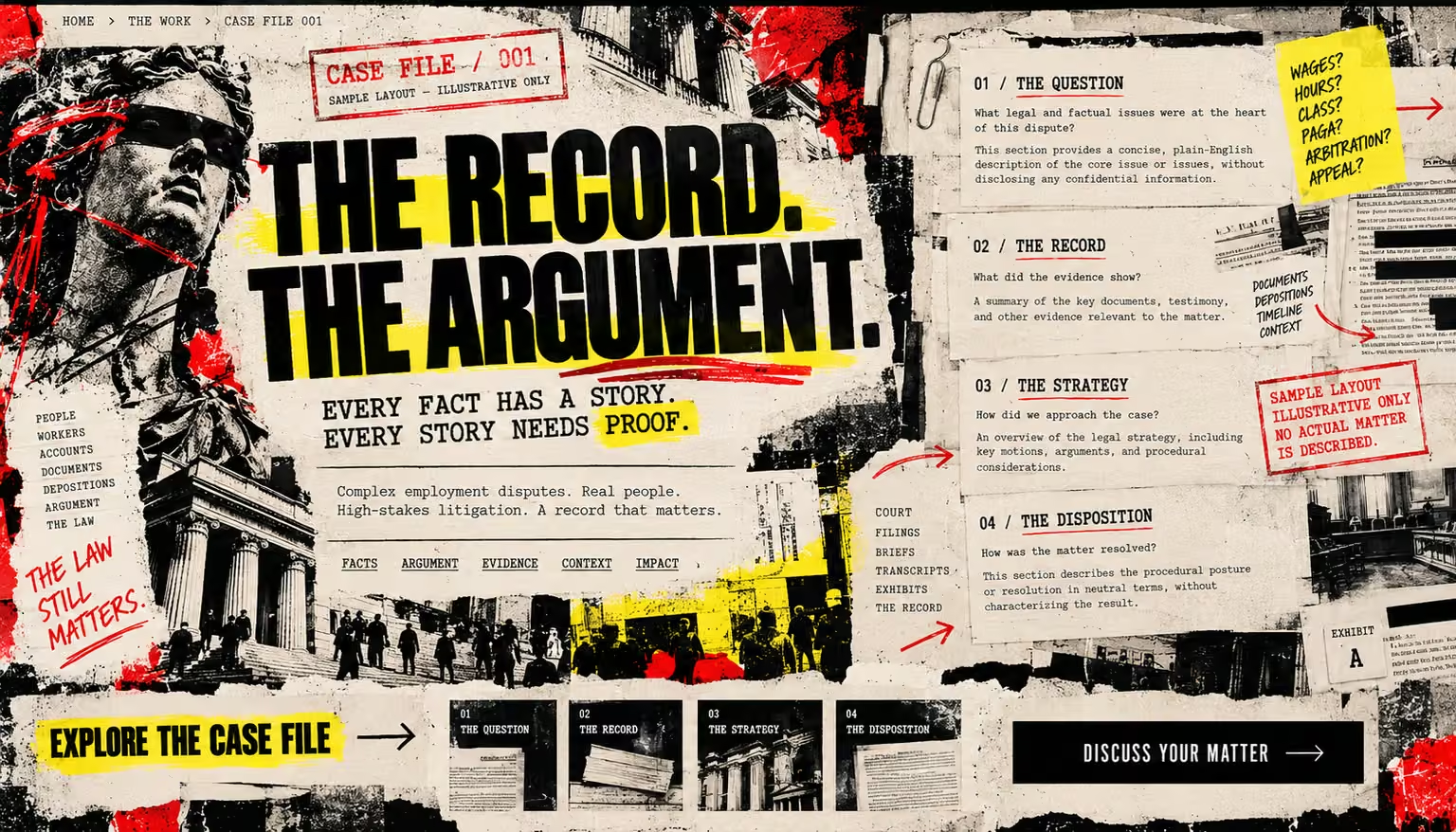
Generated illustration: people and documents are illustrative, not actual clients, this office’s lawyers, case records, or judicial endorsement.
Read the poster text
The record. The argument.
Every fact has a story. Every story needs proof. Complex employment disputes. Real people. High-stakes litigation. A record that matters.
Illustrative only
Sample layout—illustrative only. No actual matter is described.
01 / The question
What legal and factual issues were at the heart of this dispute? This section provides a concise, plain-English description of the core issue or issues, without disclosing any confidential information.
02 / The record
What did the evidence show? A summary of the key documents, testimony, and other evidence relevant to the matter.
03 / The strategy
How did we approach the case? An overview of the legal strategy, including key motions, arguments, and procedural considerations.
04 / The disposition
How was the matter resolved? This section describes the procedural posture or resolution in neutral terms, without characterizing the result.
Margin notes and navigation
Home. The work. Case file 001. People, workers, accounts, documents, depositions, argument, the law. The law still matters. Facts, argument, evidence, context, impact. Wages? Hours? Class? PAGA? Arbitration? Appeal? Documents, depositions, timeline, context. Court filings, briefs, transcripts, exhibits, the record. Exhibit A. Explore the case file.
Discuss your matter
Contact the law office using the limited initial-inquiry instructions. Decorative document markings are not actual evidence or records.
ILLUSTRATIVE FRAMEWORK ONLY NOT A DESCRIPTION OF AN ACTUAL CLIENT MATTER OR RESULT
THE RECORD. THE ARGUMENT.
Every legal claim begins in a world of conflicting accounts. The work is to separate what can be proved from what is assumed, connect the record to the governing law, and present the argument precisely.
WHAT HAPPENED?
Identify the legally significant events without forcing the facts into a theory too early. An accurate chronology will often reveal which questions matter most.
WHAT CAN BE PROVED?
Examine contemporaneous records, witness testimony, payroll information, policies, and contradictory accounts. Record what is missing, too.
WHAT DOES THE LAW REQUIRE?
Evaluate the applicable statutes, controlling decisions, defenses, burden of proof, and procedural posture before deciding how to proceed.
WHAT COMES NEXT?
Some situations call for litigation. Others call for negotiation, administrative relief, or no claim at all. Sound judgment includes knowing the difference.