The field guide: janitorial workers
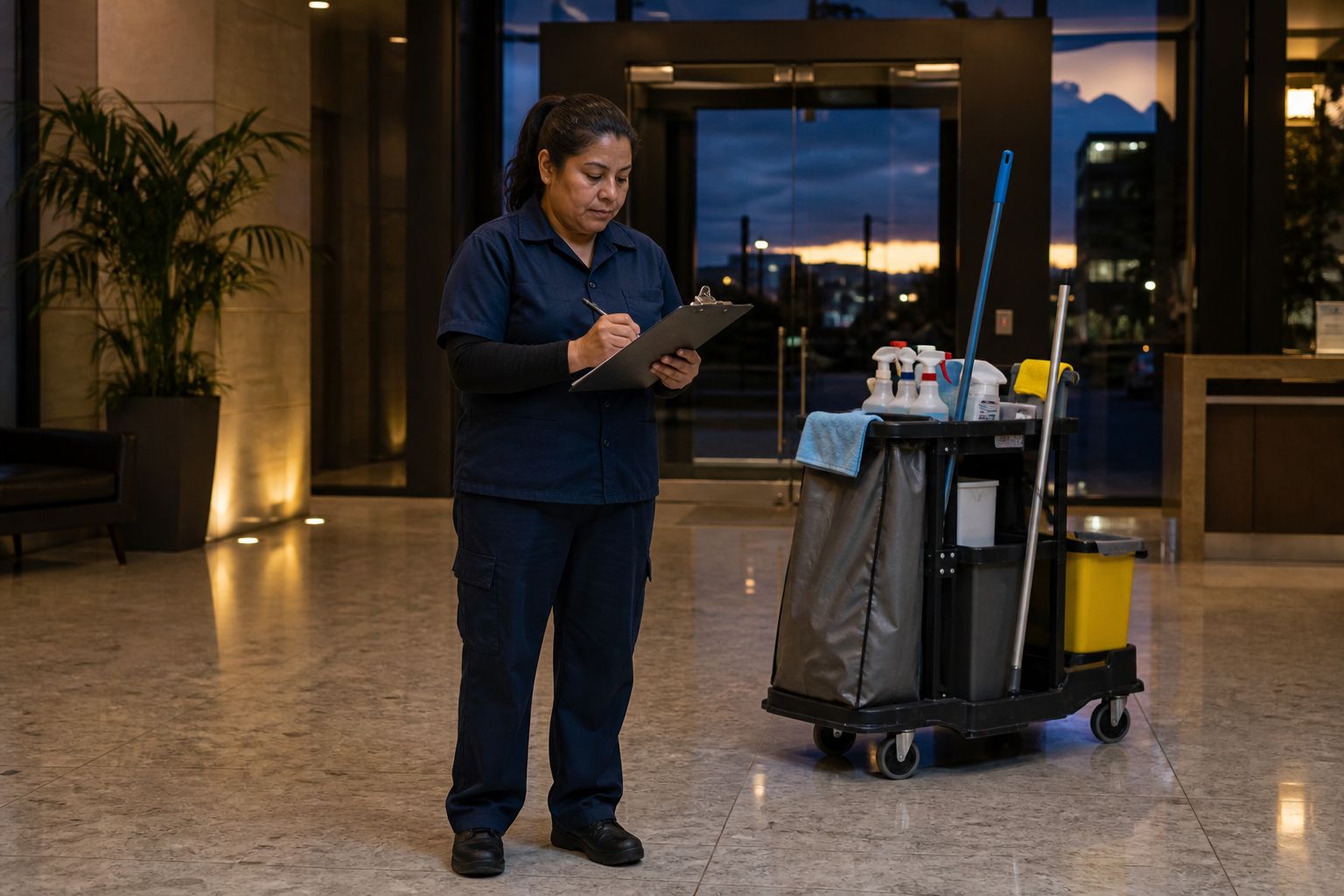
California wrote a statute for the night shift: janitorial employers must register with the state, their workers must receive in-person harassment-prevention training, and the wage judgments that used to die with dissolved companies now follow the contracts. The building may be empty at 2 a.m.; the law is not.
1 · A registered industry, by design
The Property Service Workers Protection Act exists because of what isolation at night made possible in this industry — documented in the reporting that preceded the law. Its architecture: janitorial employers must register annually with the Labor Commissioner; hiring an unregistered janitorial contractor is itself unlawful for the client business; and the Act mandates sexual-violence and harassment prevention training, delivered in person, in a language workers understand, on paid time.1 A cleaning company that never registered, or a building that contracts with one, has violated the industry’s ground rules before any individual claim is examined — and those threshold violations set the tone for everything a case later alleges.
2 · Judgments that follow the work
Janitorial’s classic evasion was succession: the contractor with wage judgments dissolves, a successor with the same accounts and the same crews appears, and the debt stays behind. The Act answers with successor liability — an entity that continues the business, the contracts, or the workforce can inherit the wage obligations — and the client-business rules our joint-employment primer describes put the building’s operator in the frame as well.2 The practical meaning for a worker owed back pay: the company’s name change is an inconvenience, not an escape, and the building itself is rarely as far from liability as it believes.
3 · The night shift’s wage mechanics
The violations here are the wage cluster under cover of darkness. Square footage assigned per shift that arithmetic cannot fit into paid hours — an off-the-clock case stated in floor plans. “Independent contractor” janitors supplied to buildings by the company whose business is janitorial — prong B, again. Split buildings and split entities fragmenting one night’s work across two payrolls. Meal periods that exist only in the schedule software, in buildings where the worker is alone and relief is structurally impossible — premium pay, accruing nightly. And the training mandate ignored entirely, which is both its own violation and, in a harassment case, devastating evidence on the failure-to-prevent count.
4 · Harassment, and the statute’s reason
Work alone, at night, in someone else’s building, often newly arrived and paid in ways designed to be deniable — the Act’s training and registration rules exist because this combination was exploited, repeatedly. The general harassment law this library maps applies with full force: strict liability for supervisors, the client building’s negligence exposure once on notice, personal liability for the harasser. What the janitorial statute adds is context a jury understands instantly: an industry Sacramento found dangerous enough to regulate by name.
5 · Your paper trail
The company’s name as it appears on your check — and every name it has used. Your building assignments, square footage, and shift times, in your own log. Whether you ever received the in-person training, and in what language — note it plainly; its absence is a fact you are qualified to testify to. Texts with supervisors about coverage and workload. And the registration question we can answer in minutes from the state’s public roster. Night work made this industry hard to see. The statute turned on the lights; bring us the log, and we will use them.
Notes
- Lab. Code §§1420–1434 (Property Service Workers Protection Act).
- Lab. Code §1434 (successorship); §2810.3 (client businesses).
Related writing: Harassment after section 12923 · Two companies, one job · Sus derechos en el trabajo
This article states California law as of its revision date and is analysis, not legal advice. Reading this site does not create an attorney-client relationship. Attorney advertising.