The field guide: retail and fast-food workers
A dedicated fast-food wage floor, pay for shifts that evaporate, a right to a seat the Supreme Court enforced, and local ordinances that fine chaotic scheduling. The counter has more law behind it than the head office admits.
1 · The wage floors, plural
Fast-food workers at large national chains have their own statutory minimum wage, set above the general floor by the 2023 legislation and its council — a floor that also drags exemption thresholds upward for the sector’s “salaried” managers, many of whom stop being lawfully exempt the day the floor moves.1 Retail generally runs on the standard minimum, but check your city: local minimums routinely outrun the state’s. The floor that applies is the highest one that covers you; payroll systems are optimists about which that is.
2 · Pay for the shift that wasn’t
Retail scheduling generates the industry’s signature violations. Reporting time pay: report for a scheduled shift and get cut early — or told on arrival you’re not needed — and the wage orders owe you partial pay for the shift anyway.2 California courts have applied the same logic to on-call scheduling that makes you call in two hours before a shift that then evaporates: requiring you to hold the time can require paying for it. Predictability pay: in Los Angeles and San Francisco, fair-workweek ordinances go further for covered retail workers — advance schedules, premiums for employer-initiated changes, rest between clopens. If your schedule changes more often than your manager’s story about it, there is likely money attached.
3 · The seat, the search, and the register
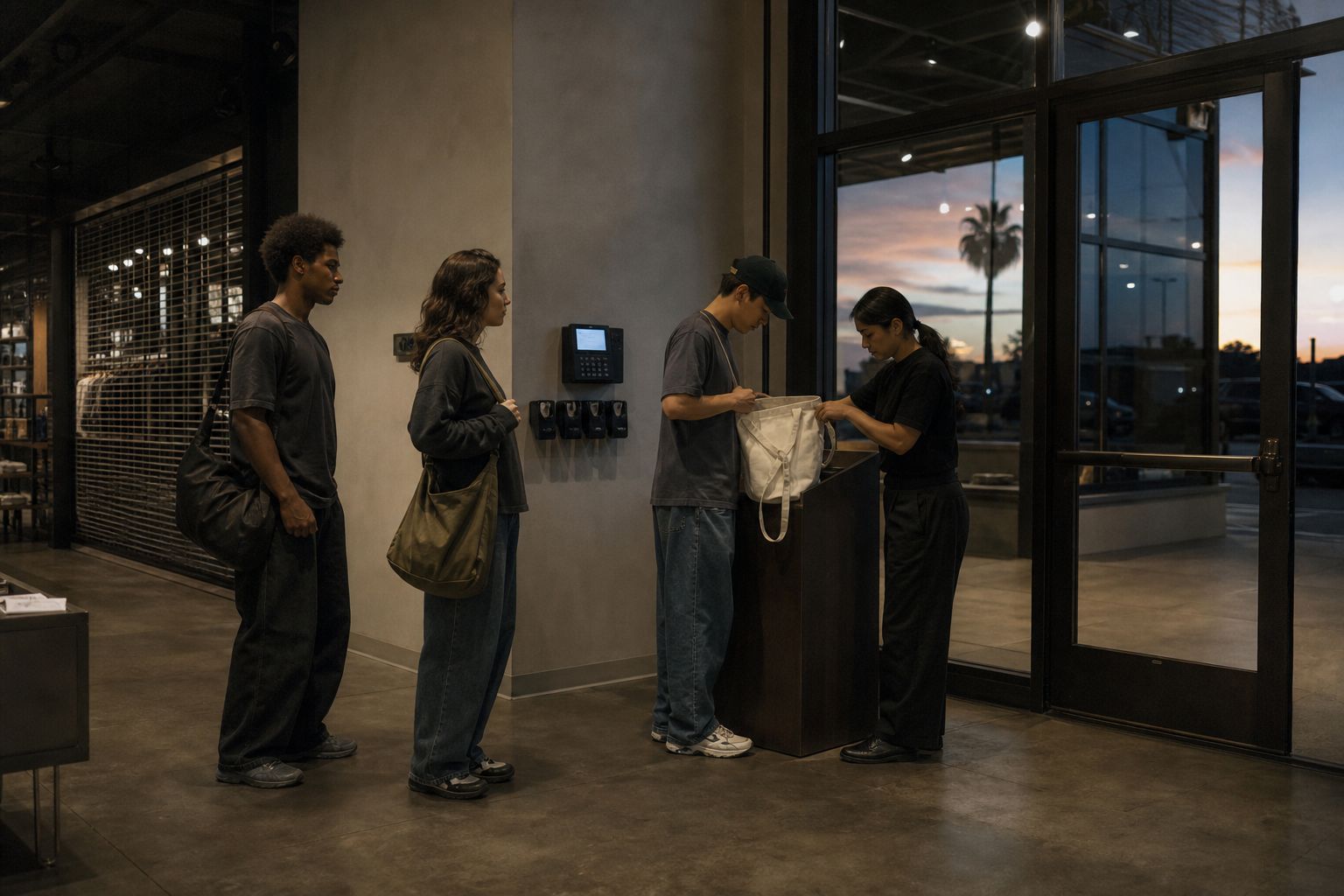
Three small rights with Supreme Court weight behind them. Seating: the wage orders entitle employees to suitable seats when the nature of the work reasonably permits — evaluated task by task at the register, not by the job title — per Kilby.3 Security checks: time spent in mandatory bag checks and exit searches is worked time under Frlekin — minutes at the door, every shift, that compound exactly like the warehouse gate. The drawer: register shortages deducted from pay are unlawful in almost every configuration; a shortage is a business cost, not an employee fine.
4 · Patterns to examine
Clopens with neither rest nor the local premium. Schedules posted late and changed silently, in ordinance cities. Sixteen-year-old wage statements — metaphorically — that fail the annotated-stub test. “Assistant managers” at chain stores running registers eight hours a day on an exemption the arithmetic long ago dissolved. And the retaliation cluster: hours quietly zeroed after a complaint — in this industry, the schedule is the adverse action, and a schedule history is evidence with timestamps.
5 · Your paper trail
Photograph every posted schedule and keep the app’s change notifications — the scheduling record is the industry’s confession log. Keep stubs; run the five-line check. Note the seat that was never provided and the tasks you did standing. Log the door-check minutes for two ordinary weeks. If the pattern you document runs one direction — it will — send it to us. Retail cases look small one shift at a time; so did the warehouse minutes, and the meal premiums, and every other small number this library has taught readers to multiply.
Notes
- Lab. Code §1474 et seq. (fast-food sector wage floor and council).
- IWC Wage Orders 5, 7, §5 (reporting time); see also the on-call scheduling decisions applying it.
- Kilby v. CVS Pharmacy, Inc. (2016) 63 Cal.4th 1; Frlekin v. Apple Inc. (2020) 9 Cal.5th 73.
Related writing: Exempt or not: your title is not the test · Meal periods, rest breaks, and the hour of pay most workers never see · A wage statement, annotated
This article states California law as of its revision date and is analysis, not legal advice. Reading this site does not create an attorney-client relationship. Attorney advertising.