The field guide: security officers
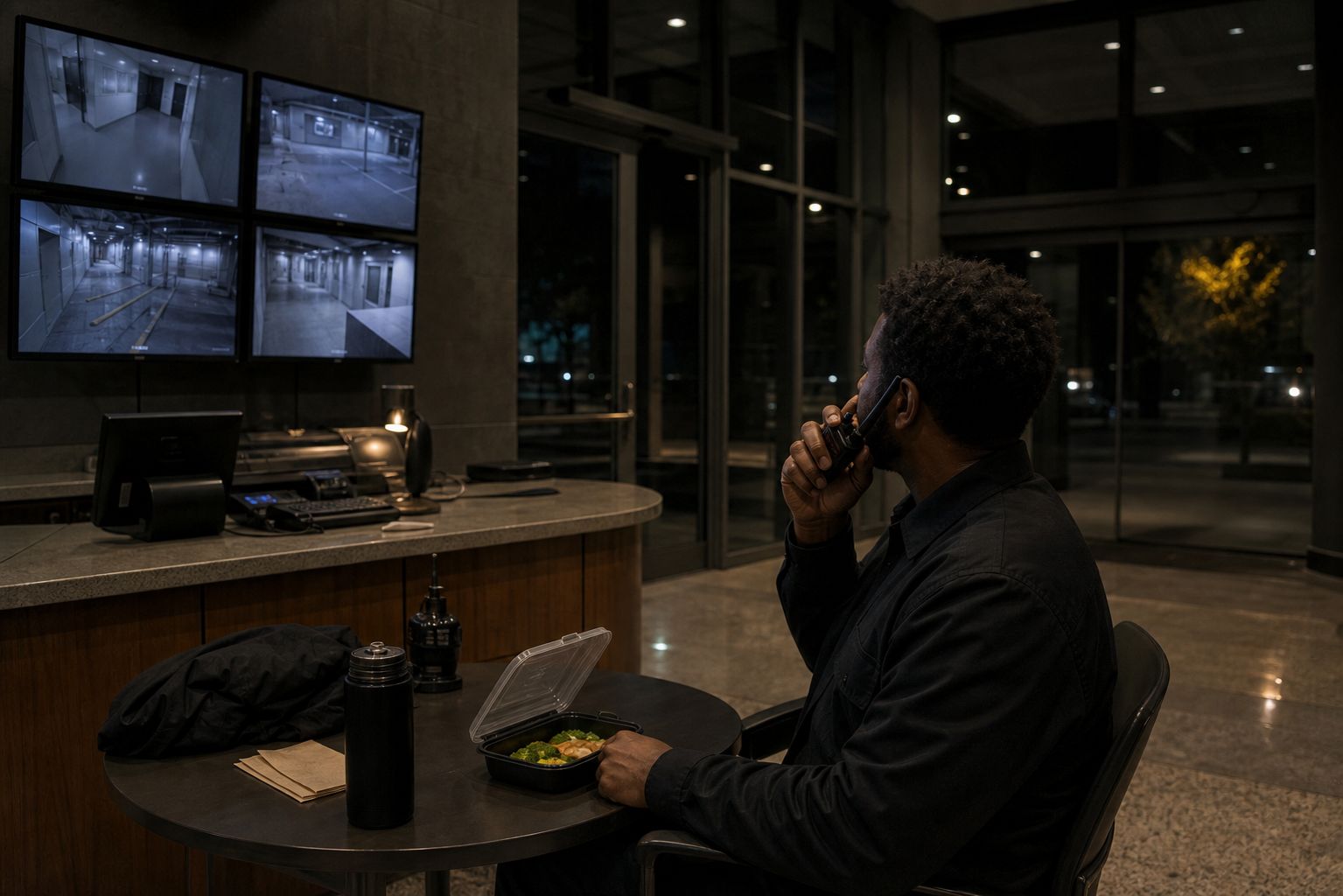
The two California Supreme Court cases that define on-call time were both security cases. Your industry wrote the modern law of the radio on your hip — and still violates it nightly.
1 · Your industry’s own Supreme Court cases
When California decided what “off duty” means, it decided it on security facts. Mendiola: guards required to live on-site in trailers, “on call” overnight — the court held that hours under the employer’s control are compensable, even hours spent sleeping, where the employer’s restrictions make the time its own.1 Augustus: guards required to keep radios on and respond during rest breaks — the court held an on-call rest break is no rest break at all.2 Between them, the doctrine your posts run on every night: control converts time into wages, and the radio is control. A “break” spent monitoring the channel is work; a standby hour you cannot meaningfully use is work; the post you cannot leave is the post paying you.
2 · The solo post and the on-duty meal
Security is the natural home of the on-duty meal agreement — the narrow exception allowing a paid, working meal where the nature of the work genuinely prevents relief. Its requirements are strict: the nature of the post must actually prevent relief, the agreement must be in writing, revocable at will, and the meal is paid. A company that staffs every post solo and papers every guard with the same “agreement” has not satisfied an exception; it has confessed a staffing model — and where the conditions fail, every workday owes the premium hour our meal-and-rest primer describes. Rovers who could have provided relief, but were never scheduled to, are the deposition topic this industry dreads.
3 · The guard card and the gear
The industry runs on state licensing — the guard card, with its registration and training hours. Watch where the costs land: training time an employer requires is generally compensable time, uniforms are the employer’s expense under the wage orders, and required equipment follows the same rule. And watch the arithmetic of the “training rate” — a sub-minimum onboarding rate is not a thing California law recognizes.
4 · The contract seam
Most officers work for a security company at someone else’s property, which puts the whole joint-employment analysis in play: the client site that directs post orders, sets schedules, and demands removals is exercising employer-grade control, and the assignment ended by client request after a complaint is an adverse action with two responsible names on it. Post orders, incident reports, and removal emails are the industry’s paper trail of who actually controlled the work.
5 · Your paper trail
Post orders, as issued — photograph each version. Your DAR/incident reports: they timestamp your actual duties. Radio and phone logs where you lawfully have them. The on-duty meal agreement, if one exists, and the staffing reality around it — how many officers, how many posts, whether relief ever actually came. Schedules showing solo coverage. Then write to us. This industry’s two defining cases were brought by guards who kept their records; the law they made is waiting for the next one who does.
Notes
- Mendiola v. CPS Security Solutions, Inc. (2015) 60 Cal.4th 833.
- Augustus v. ABM Security Services, Inc. (2016) 2 Cal.5th 257.
Related writing: Meal periods, rest breaks, and the hour of pay most workers never see · Two companies, one job · Huerta — the gate, the drive, and the clock
This article states California law as of its revision date and is analysis, not legal advice. Reading this site does not create an attorney-client relationship. Attorney advertising.